


GLORY - Chapter 2 is the second exhibition in the partnership between KØN and artist Kim Richard Adler Mejdahl. Here, KØN’s cultural-historical collection of objects is reinterpreted under the title From Cradle to Grave. In this artistic reading, our social rituals are placed alongside the Norns – the Nordic goddesses of fate – in an exploration of how we are shaped by gender roles from early childhood and throughout life. In these rooms, the Norns hold power over our gendered destinies, and from the very first moment they spin the thread of life with gender reveals, gender-coded baptism decorations, and conforming uniforms.
"The exhibition series GLORY explores how, through naked bodies, morbid jokes, and vulnerable personal narratives, we may move beyond patriarchal culture toward a more inclusive world. Everything is viewed from a queer perspective, as I have felt the blows of patriarchy in a deeply personal way through my sexuality."
– Kim Richard Adler Mejdahl
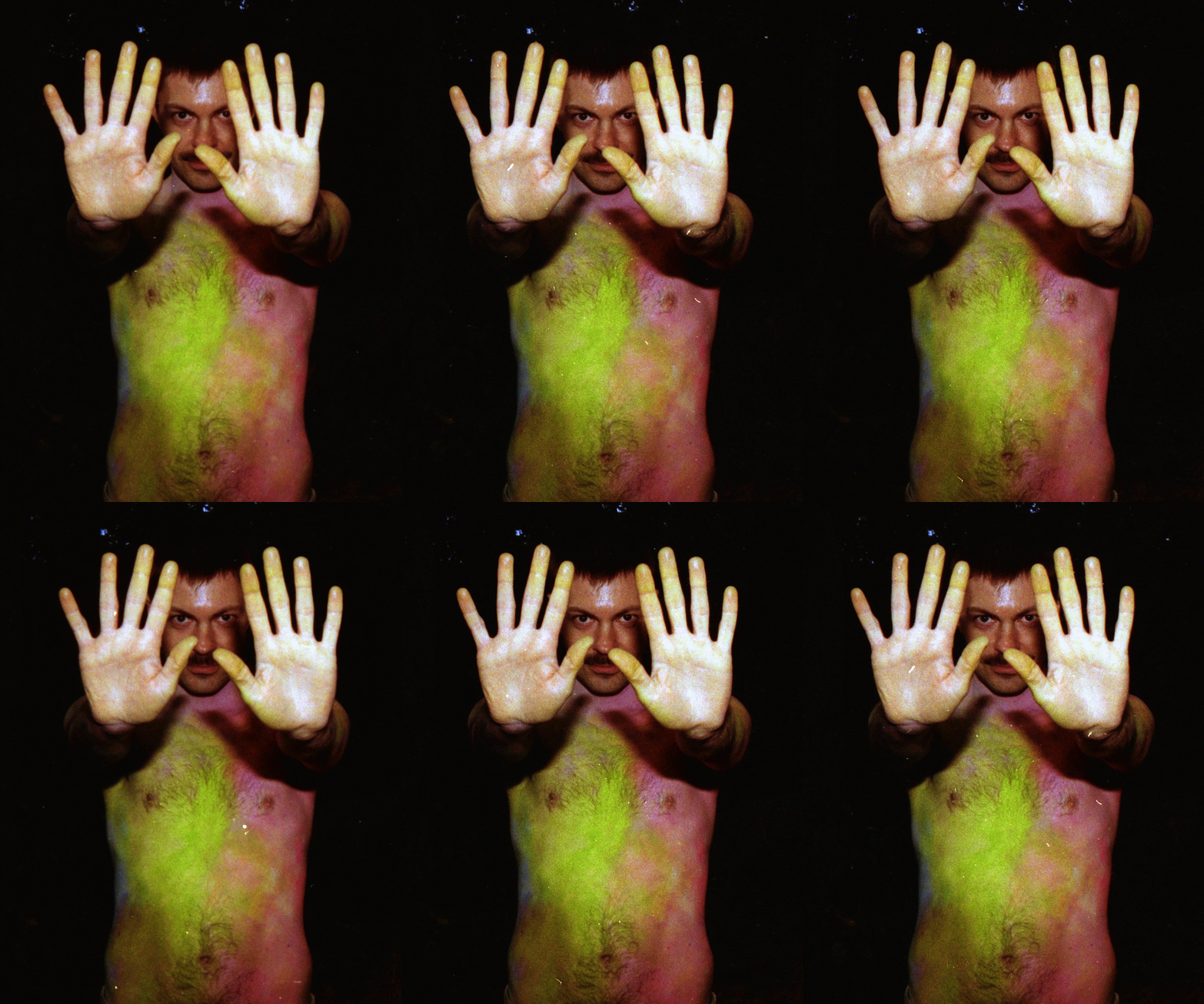


(Public Dream Archive)

Kim reached out across Denmark with an open invitation for people to submit their dreams to the artist’s dream archive. 50 were selected for the exhibition, and Kim has interpreted ten selected dreams, that will continuously be released on this page (available in English and Danish).
“Dreams come with important messages. I learned that as a child. Since I was thirteen, I’ve been writing them down. Most people don’t attach much value to their dreams, even though many seem to have one that keeps lingering in their memory.
Is it possible that a miracle is dreamt every single night – without us ever noticing? We usually think our dreams are relevant only to ourselves, but the archive was created with the idea that a dream can belong to the collective, that it can be a shared matter in the name of equality. I want to show that the personal is universal, and to me, The Public Dream Archive is a spiritual counterpart to the women’s movement’s slogan from the 1960s: ‘The personal is political.’
When we imagine a better world, we envision a utopia. We must first have a dream to begin any process of change. Imagine if a great cultural shift could start with something as humble as a small dream born in the darkness of night.
It reminds me of the story of Dumbo the elephant. Dumbo believes he can only fly when he’s holding his magic feather. Later, he discovers that he can fly without it – his great ears were enough all along. Dumbo just needed that little magical amulet to take off.
My wish is to gather hundreds of your dream feathers and transform them into a shamanic feather cape. What might happen if someone were to put such a cape on?
To my surprise, I discovered that nearly all the dreams I chose to interpret are adult recollections of their very first childhood dreams. They have survived the passage of time and remained with the dreamer throughout life. That alone proves their deep significance. They carry such a sense of destiny that they almost sound like a prophecy spun by the Norns themselves.”

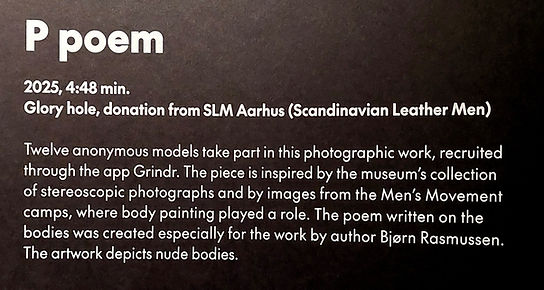
“The poem is filled with fairytale imagery – the royal castle, the apple, and the act of piercing something with a sharp object. This mysterious fusion of the masculine and the feminine. All of it echoes themes found throughout the exhibition, though Bjørn knew nothing about them when he sent me the poem. I read it as a prayer, or perhaps a spell. In the work, I chose to repeat it like a mantra.
The glory hole - which I got from a local gay sex club - renders the participants anonymous. It is impossible to know – and, in truth, entirely irrelevant – whether there is a lawyer or a street cleaner on the other side of the wall. In that moment, a kind of democracy emerges, and one of the patriarchal game board’s crucial pieces is suddenly swept aside: inside the glory hole, everyone is equal.
The hole makes me reflect that whenever patriarchal culture is hostile toward something, it is probably because that thing contains a potential for transformation. It shakes the worldview. Liberated women, queers, gay men – anything that confuses or resists the classic categorization of ‘the real man.’”

Udstillingen er kurateret, forfattet og produceret af
Kunstner Kim Richard Adler Mejdahl og kurator Marie Sommer Arnoldsen
I installeringen af udstillingen har KØN haft fokus på bæredygtighed indenfor tre områder: maling, opbygning og scenografi. Den anvendte maling er fremstillet af planter, mineraler og vand, dvs. at den er 100% kemikaliefri og uden miljøgifte, mikroplast og konserveringsmiddel. Udstillingsscenografi er i høj grad genbrug af inventar og overskydende materialer fra KØNs tidligere udstillinger.
Scenografi, interiør & inventar
Conor Murphy, Louis Fuglsang Bygholm, Mathilde Rahr, Phuong Kim Mai, Effection & Luminance
Om- og opbygning
Malermester Prince, Rosenkrads Byg, Design Gardiner, Lerbech VVS, MVS El & Kreabits
Grafisk design
Filip Grønning
AV / TEKNIK / LYS
DisplayLab, Label & Fifth
Oversættelse og korrektur
Maria Terese Mejdahl/Grammartisten, Jo Morandin/Small Planet & Henriette Sennenvaldt
Værkproduktion
Morten Jensen, Andreas Noes Brødsgaard, Outliners, Cæcilie Trier, Emma Dybdahl Hildebrandt, Anders Toft Pedersen, Bjørn Rasmussen & de anonyme bidragsydere i værket P Poem
Udstillingsfotos
Birk Thomassen
Tak til
Bent Jacobsen, John P. og SLM, Helle Albæk, Kamille Albæk, Lars Oskan-Henriksen, Tonny Bønløkke-Hertz, Steen Hansen, Ronald Zinke, Simon Reinhardt, CEN/newsX, alle anonyme danskere som har indsendt drømme og indleveret deres portrætter, KØNs personale
Udstillingen er realiseret med støtte fra
Ny Carlsbergfondet
Augustinusfonden
Beckett Fonden
Aage og Johanne Louis-Hansens Fond
CAC Fonden
Vilhelm Kiers Fond
Statens Kunstfond
Kvadrat
Tarkett